Thursday, September 26, 2013

Franck Sorbier's Silken Voyage in Time

© all photos Piero Biasion
Rubelli's Jacquard Tricorno

There has been a lot of talk about the historicizing designs of the19th century due to the Folie Textile exhibit,
but we've been repeating that trait ever since - just not exclusively. Franck Sorbier has taken historic period silks from the collections of Rubelli and Tassinari et Chatel to create a modern-romantic, 21st century Haute Couture collection Winter 2013-14.


Tassinari et Chatel fabric, Les Chimères 


Tassinari et Chatel, Argentan 


the back


Who made this damask?


Tassinari et Chatel, Cernushi 


Giotto coat et longue bustier gown Duccio in Rubelli's Tricorno 

© Photos Piero Biasion

Tuesday, September 24, 2013

The cope of St Mexme and a case of leaping leopards

model Madeleine in brown velvet Fiere 
from Luigi Bevilacqua

I stumbled across this delightful accessory recently and thought I'd propose it as the it-bag for textile lovers. It's a handmade luxury item and I have to say that I enjoy seeing those hip cat "Byzantine" leopards on the prowl again. 

photo St Tyl detail of the cope of St Mexme
If you've interested in textile history, you have may have seen these leopards before. The actual fabric is a samitum weave hanging in the Musee des Beaux Arts of Chinon. It is one of those intriguing fabrics with a long history that is all the more fascinating  because we may never unravel the truth about it's origins. It is called the Cope of St Mexme which is an ecclesiastical vestment shaped like a long cape said to belong to the abbot Mexme of  the 5th century. Most ancient textiles come down to us today either through the church or through the tomb. We have the church treasury of St Etienne in Chinon to thank for the safeguarding of this one, exceptional because of its great size and its excellent state of preservation for an ancient textile. 

Textiles of this kind of course took time to produce and were exceedingly precious.  They traveled well, as did weavers and their skills, so tracing the origins of ancient textiles is often difficult. Many Islamic or Byzantine fabrics were re-used and made into paraments - vestments or hangings for the church.  In 1853, a woven inscription was found under some trim at the top of this cope where a hood was sewn on that permitted the dating of the cloth. It reads, in Arabic, happiness to its possessor

Most textile experts consider that the cloth dates to the end of the 11th century, but where it was made remains a mystery. The Museum in Chinon states its provenance as in Moorish Spain, but I've also read Sicily and the site Qantara says Egypt. Wherever it was actually woven, it is of the rich Fatimid style which had spread throughout the Mediterranean basin during the time of the powerful dynasty from 909–1171. At some point the cloth came to France and was made into a garment but obviously, it could not have been worn by the 5th century saint. Such religious 'conversions' were frequent and didn't concern anyone; it was the quality of the cloth that mattered.

Expositions 3973
velvet Fiere 
from Luigi Bevilacqua
This fabric and the bag above come from the weaving studio Luigi Bevilacqua of Venise, one of the rare weaving houses today that still has a sophisticated hand-loom production. Designs similar to this one were created even on into the 17th century and then again probably revived in the 19th, but the Venetian design above has all the exact same elements of the ancient cope of St Mexme- confronted leopards with their young, attacking birds, tree of life. Only the leopard spots have been staggered to suit the modern eye. Does the weaving house have a piece of this same textile in is archives? Knowing the important trade relations between Venice and the East, it wouldn't be impossible. Another story of textile travel is surely behind this.

An article at Qantara explains the subject, "Decorations comprising animals facing each other on a symmetrical axis had been used in Middle-Eastern countries (Iran and Iraq) since Antiquity, particularly on cylinder seals. The vegetal axis symbolized—at least during the Sassanian period in Iran—the tree of life associated with the primordial waters; it is part of Persian cosmogony, which influenced—and still influences—Iranian art....This type of decoration spread rapidly throughout the East and was also adopted in the West."


Fiere 32973
brocatelle Fierefrom Luigi Bevilacqua
"The tamed leopards evoke one of the favourite themes of oriental artists: the prince’s hunting exploits, the symbols of his power, which were crowned with a banquet and music. In the Umayyad period, treatises on hunting mention animals used for hunting: dogs, falcons, and leopards—highly prized animals which required specialist training. Certain sculptures in the round from China (Tang Dynasty), which depict a huntsman carrying a leopard on the croup of his horse, suggest that this type of hunting is Chinese in origin. It quickly spread throughout Islamic countries and appeared on luxury objects, such as ivories, and was combined with hunting using a falcon: in Spain during the caliphate period, Sicily in the eleventh and twelfth centuries, and Fatimid Egypt. It spread to the West through Muslim Spain."


Photo : Handmade bag with our Leoni Bizantini 32173 velvet by Köln based Anette Stahlhofen.
Further info: http://a-stahlhofen-taschenmanufaktur.de/
bag from stahlhofen-taschenmanufactur
For the pleasure - for variety - there is also a Byzantine Lion bag.
Which will it be?

Wednesday, September 18, 2013

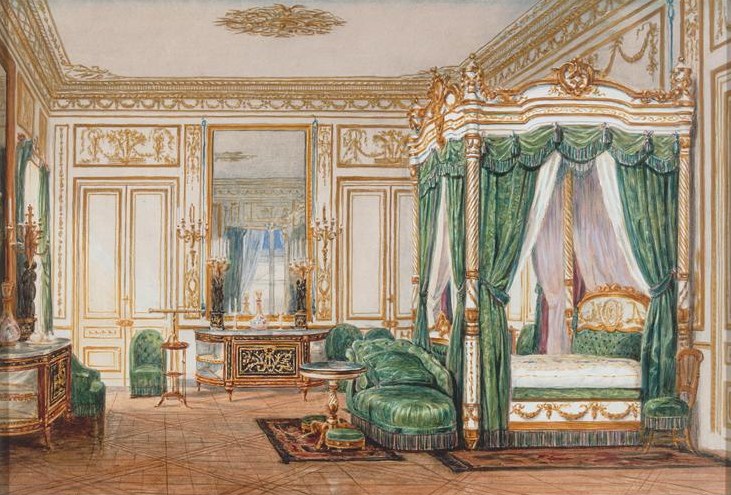
3 Beds for Empress Eugenie


File:La chambre à coucher de l'Impératrice Eugénie.jpg
Jean Baptiste Fortuné de Fournier
Eugénie's bedchamber at the chateau of St Coud
Empress Eugénie knew what she liked.
 In matters of foreign policy she had strong opinions and she often held sway, and in dress and decoration, 
she always had her way. 

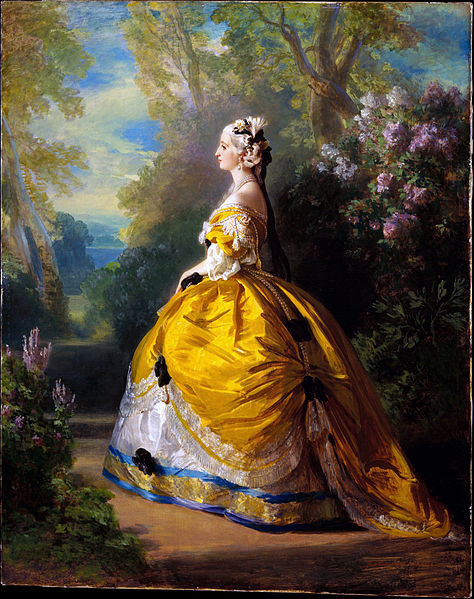
File:L'impératrice Eugénie à la Marie-Antoinette, 1854, Franz Xaver Winterhalter.jpg
Eugénie wearing powder and panier as Marie-Antoinette
Winterhalter

The wife of  Napoleon III identified with Marie-Antoinette.  
To Marie-Antoinette's, l'autrichienne,  she answered to another echoing sobriquet , l'espagnol.

When you are exploring the style Napoleon III, look closer, you may be looking at the style Louis XVI-Impératrice. The Garde-Meuble and even the Louvre contained the best examples of Louis XVI furnishings in Empress' day and she determined she would have them for her personal use. Sometimes she had made admirable copies of these pieces with the talent of perfectionist cabinet maker, Georges Grohé. With the addition of gold leaf and bronze she hoped to make these creations surpass the originals. Philippe Jullian gently mocked when he said  "as a good Spaniard, she liked that which glittered. "


The bed shown in the previous post where I spoke of the exhibit Folie Textile is a pure Louis XVI-Impératrice  creation. It was made for the Palais de l'Elysée 146 years ago,but has lived its life at the Palais de Compiègne for 104 years. The Empress intended this bed to welcome Empress Elisabeth of Austria when she accompanied her husband Franz-Joseph on his visit to the 1867 World's Fair. Laure Chabanne's article in the exhibit catalogue states that the white and gold Louis XVI style bed was similar to two others already created for her own use at the chateau of St Cloud in 1855 and of the Tuileries in 1853. The thrice repeated style seems to have been a special way to honor Elisabeth to whom she was very close.


 Having just undergone a 6 year restoration, the bed in all its Second Empire splendor is a key piece at the exhibit. 200 meters of emerald silk damask were woven by Georges Lemanach (which recently became part of the Pierre Frey group) to match the original ; 132 meters of fringe and 78 ornaments of passementerie - tiebacks, tassels, braid - were re-created by Declerq Passementier.


The headboard and the inside of the canopy retain the original 19th century tufting of a damask by Maison Mathevon et Bouvard, Lyon which has been restored, not reproduced and which accounts for the different color. 

The Empress Sissy as it turned out did not accompany her husband to Paris on that occasion. The bed was never used, but stored until it was moved to the palais of Compiègne to join the imperial apartments and later the museum of the Second Empire.  It remains as a strong reminder of Eugénie's taste and impressive example of the textile mania of the day.

all photos Musées et domaine nationaux du Palais de Compiègne © RMN –Grand Palais (domaine de Compiègne) / Christophe Chavan


Monday, September 16, 2013

Folie Textile: the magnificent madness of the French Second Empire

Empress Eugénie's bed originally from the Palais de l'Elysée 1867
today at the palais de Compiègne
original damask by Maison Mathevon et Bouvard, Lyon
photo:  RMN-GP/Christophe Chavanli
What would the Second Empire be without its swags, valances and tufting? 

Alfred Stevens La Robe Jaune
Or the Second Empire woman, without her crinolines and the double-digit yardages of fabric necessary for her dresses? 

grand magasin second empire source La soie en occident

The Second Empire in France corresponds to the dates of Napoleon III from 1850-1868, but the style continues on until 1890, roughly corresponding to the Victorian period in England. The wonderful exhibit entitled Folie Textile, reminds us not only of the shapes and colors of the day, but that a fever raged for nearly half a century when textiles were consumed without moderation for dress and decoration.


JPEG - 155 ko
salon Princess Mathilde Saint Gratien by Charles Giraud
image souce: La Tribune de l'Art
Textiles had been forever a symbol of opulence among the aristocracy and when the industrial revolution made them more widely accessible than ever before, a craze broke out in society close to madness. This exuberant trend spread to simpler bourgeois interiors, the perfecting of Jacquard looms, printing cylinders, and sewing machines all playing a role in spreading the joyous contagion.

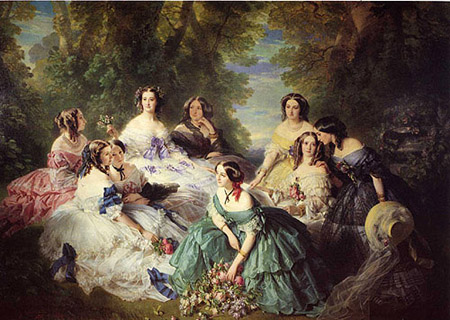
Eugénie and her dames d'honneur by Winterhalter

After a period of upheaval and economizing, this was an era of seemingly lighthearted  fêtes into which was born capitalism and consumerism. Mail order catalogues circulated in abundance and Au Bon Marché, the first of the grands magasins or department stores, opened in 1852 making material desires easier to satisfy.  The Empress Eugénie and her dames d'honneur set a festive tone by displaying the latest luxury creations of the textile industry with a dizzying array of gowns, changed several times a day.

silk by Lamy et Giraud,design by Beuchot 1867
manufacture Prelle
Néo-Renaissance silk lampas known as Tête de Mélusine

It's as if an immense hunger seized society, commanding it to catch up on all the bygone days when it craved  cloths and other objects of which  it had been deprived. So who could blame them? They fed their fever with articles imitating the Middle Ages, Renaissance, Rococo, Louis XVI - Turqueries, Chinoiseries and designs from other exotic lands. Historicizing and eclectic, they devoured the silks and chintzes, velvets and brocatelles that had the fresh savor of the Second Empire. 

Grand Frères Lyon, 1866
Tassinari et Chatel, Paris
Satin curtain with a brocaded Chinese-inspired border from the hotel of the Marquise de Paiva.

cotton block print Alsace 1866, Mulhouse musée de l'Impression sur étoffes 

Print imitating embroidery to make up an Indian jeweled flower design. Note the shadows that give 3-D quality. Printed fabrics and wallpaper had a jollytime with trompe l'oeil.

Alsace 1868, Mulhouse musée de l'Impression sur étoffes 

Cotton print with fantasy 'Arabic' calligraphy. It was the spirit that counted not a true inscription.

Alsace 1866
Palais de Compiènge

 Fabrics imitating fabrics. Many prints imitated weaves and moiré undulations as in this glazed percale perse that is part of bed hanging on display. A naturalistic depiction of flowers and botanicals was in vogue. This was the the period that gave birth to the 'jardin d'hiver'.

Printed fabrics are well represented in the period and mostly considered suitable for bedrooms whereas the salon would have been more richly outfitted with brocades and velvet. A new, less expensive alternative to velvet was reps, a fabric with transverse ribs made of silk or cotton and wool that could be woven or printed to look like tapestry.  

Raymond Ronze 1867 Lyon
Lyon, musée des Tissus
A very subtle and beautiful 'painted' brocatelle made of silk and linen. 
Its warp was printed before weaving giving the flowers more sculptural relief with watercolor-like shading. 
One of my favorites in the exhibit.
portrait Napoleon III by Maison Furnion, design Auguste Malpertuy, 1855
Lyon, musée des Tissus
The Emperor's directives, a new ease of production and an undeniable prosperity also made it possible to make textile creations of outstanding prowess. The finely sculpted effect of this cut velvet on a satin ground are astounding had me thinking of metal repoussé. It was presented as velours broderie at the World Exposition of 1855.


Maison Bérard, Poncet & cie Lyon  1861
Lyon, musée des Tissus
This silk velvet panel possibly created for Queen Victoria has an immense delicacy of rendering and fine transparent effects rarely seen in velvet. It was presented at the World's Exposition of 1862.

passementrie
palais de Compiègne

And where would we be without passementrie ? Yes, it's the icing on the cake.

Lovely, superfluous, daring.


Philippe Jullian said of the Second Empire,

Le mobilier Second Empire est provocant dans ces ornements, compliqué dans ses formes; les amours pullulent, le pastiche semble triompher; il est pourtant très original, peut-être superbe ou ravissant.

Second Empire furniture is challenging in its ornaments, complicated in its shapes; 
putti abound, pastiche seems to triumph, yet it is very original and may be exquisite, 
even touching.


The exhibit site is one hour north of Paris at the Palais de Compiègne.
An excellent catalogue to the exhibit, Folie Textiles, mode et décoration sous le Second Empire is available with thorough illustrations and fascinating texts (French).


Tuesday, June 25, 2013

A fabric for Clémentine d'Orléans at the Grand Trianon


Marie-Clémentine d'Orleans Princesse de Saxe-Cobourg-Gotha 
in a painting by Winterhalter
The last king of France, Louis-Philippe had a particularly intelligent daughter, Clémentine d'Orleans 1817-1907, who became the princess de Saxe-Cobourg. This youngest daughter was so well-known for her ambition and intelligence in political  matters that she received the nickname of 'the Medici of the Cobourgs.' French history is filled with intelligent, influential women and we are reminded of many through the objects they left behind. Before her marriage and installation in the Cobourg palace in Vienna, the young woman naturally she lived with her family in the Palais Royal, the château des Tuileries, and the Grand Trianon. 


source:stylirex
The curator of the Grand Trianon recently found a chair in storage that has been traced to Cléméntine. The bare bones of the chair, similar to the above reproduction, were in need of adequate upholstery and a fine silk to attest to the memory of this most accomplished princess. Tassinari & Chatel has agreed to share some of what goes on behind the scenes in the case of  such a recreation. Those interested in European textile history will recognize the names of Pernon and of Grand Frères, encompassed now by Tassinari & Chatel. The silk weaver's rich past is attested to by 100,000 textile archives.

photo Tassinari & Chatel
Research was first conducted in the Livre de Commandes (order book) of the period . Many a decorative project can be traced there, including those for Malmaison, Fontainebleau, the Elysée, Versailles, the White House, the Ritz... to name but a  few. To make research more of a challenge, certain orders are written in an ancient and obscure stenographic text to assure the extreme discretion demanded by clients concerning their projects.
This particular chair was not found in the records, but the project was not to stop there.


photo St Tyl
 Silk weaver and curator reviewed many designs of the period, until one stood out, a floral by the artist, Grandbarbe. Grandbarbe was very much appreciated for both the original designs of his early career and the re-interpretations of earlier designs for this period that was just beginning to become eclectic and historicizing. It may be that the spirit of Clémentine was guiding their choice because the design fit the proportions of her dainty chaise gondole perfectly!

photo Tassinari & Chatel
The woven document from the archives is of great finesse. Here, the record clearly states that the fabric, a brocaded lampas was designed by Grandbarbe in Louis XVI style and provides a sketch of the design.


photos St Tyl

As we have seen before, here, the back of a fabric is just as eloquent as the front. To the left, the back of the original mid 19th century archival document. The lampas technique is used for the grisaille patterns of foliage pearls and vases on a satin ground;  the brocaded effect is as if embroidered  is seen in the 'extra' blue, pink and green threads. This is a sure sign of hand woven fabric. The cloth such as this would have been woven face down as the weaver brocaded the colorful flowers with tiny espolins or brocading shuttles. A corner of the document is stamped Grand Frères, the name of the entreprise during most of the 19th century.

photo St Tyl
If the woven document still exists, 
the mise en carte or technical drawing had been lost to the sands of time.
It was necessary to reconstruct this essential element 
that serves to command the loom before the weaving could begin. 

photo St Tyl

Even with today's computer technology the mise en carte is a long painstaking process 
for a design as rich as this one.
 It took approximately 100 hours to complete the drawing. 

photo St Tyl
then and now

Here we have the original document on the left woven in a width of 54 cm. The weaving for the restoration was reproduced in the same proportions by inserting the design onto an expanded field of satin 
within the space provided by modern loom widths. In fact, two full panels were woven side by side between the selvedges in the 130cm width; the fabric here has been cut down the middle.

photo St Tyl
then and now

The modern version is made entirely in the lampas technique where decorative wefts are 
completely attached to the back of the fabric by a second warp. 
While the fabric loses the extreme lightness of handle of the original, it gains strength - 
an excellent idea for upholstery.

photo: Grand Trianon
Louis-Philippe, the so-called roi bourgeois, did not wish to occupy the château of Versailles, but installed his family next to it in the Grand Trianon. There he found it necessary to make some changes to accommodate a different lifestyle - and his 8 children.
Clémentine occupied apartments that had first belonged to
Mesdames de Maintenon and de Pompadour, then to Napoleon I.
Her freshly upholstered chair can be found there today.

Friday, June 21, 2013

Uplifting Clouds at Kenzo


photo St Tyl
It has been cloudy lately in Paris - even inside at Kenzo at la place des Victoires.

photo Kenzo
day clouds

photo Kenzo
night clouds
photo Kenzo

There's always an eyeful of original fabrics there. 

more on their site Kenzo

Wednesday, June 19, 2013

Salon des Fleurs Chateau de Compiègne


photo St Tyl

This is the Salon de Fleurs in the Château of Compiègne, formerly a royal and imperial residence. I wandered these rooms over the week-end when I went to see the exhibit Folie Textile, a wonderful show that explores the exuberant production and use of textiles at the time of Napoleon III, 1848-1871. That exhibit and some important restoration work in historic sites is making the 19th century weigh heavily in decorative world's time line these days, provoking a certain rediscovery of  decorative arts of the mid to late part of the century. More on that soon, but for today...

The Salon des Fleurs was a game room for Empress Josephine - specialty tables are scattered for playing  trictrac, quadrille, bouillotte. 
(Trictrac is backgammon. Does anyone know the names of these other games in English?)

Compiègne, le salon des Fleurs
source: Napoleon III
An important thing to remember is that in the 19th century very often fabrics were used that were woven for a prior reign (new olds) and older decors were sometimes kept by the various regimes that succeeded each other - Louis XVI, Louis XVIII, Charles X, Louis-Philippe, Napoleon III.  The reasons: availability, economy, emulation.

During the Second Empire of Napoleon III, the salon was used as a bed chamber for the Imperial Prince  The young prince scratched the date 4 décembre 1868 into the marble table 
and

Compiègne, salon de jeux du Prince impérial
Bourdelin, (c) RMN

played his games in another well-dressed room. 

photo St Tyl

The Salon des Fleurs takes its name from its decoration. The oil panels painted in 1809 and 1814 
by Dubois were  based on the work of Pierre-Joseph Redouté.

photo St Tyl

The armchairs and settees by Jacob-Desmalter are covered in Gobelins tapestry.The 18th century floral design by Louis Tessier of was chosen by the Empress Josephine and delivered in 1809 - once again,  
an example of  the blending of stylistic frontiers. 

photo St Tyl
detail of the canapé

The ground of the tapestry is a fair lilac shade with a band 
of crisp, violet grosgrain to give  the finishing touch. 
These tones will deepen in textile design as the century progresses even to deep purple and become very popular with the advent of color-fast aniline dyes.

photo St Tyl
A tender, watercolor quality still comes through in this 1st Empire /early 18th century tapestry.